

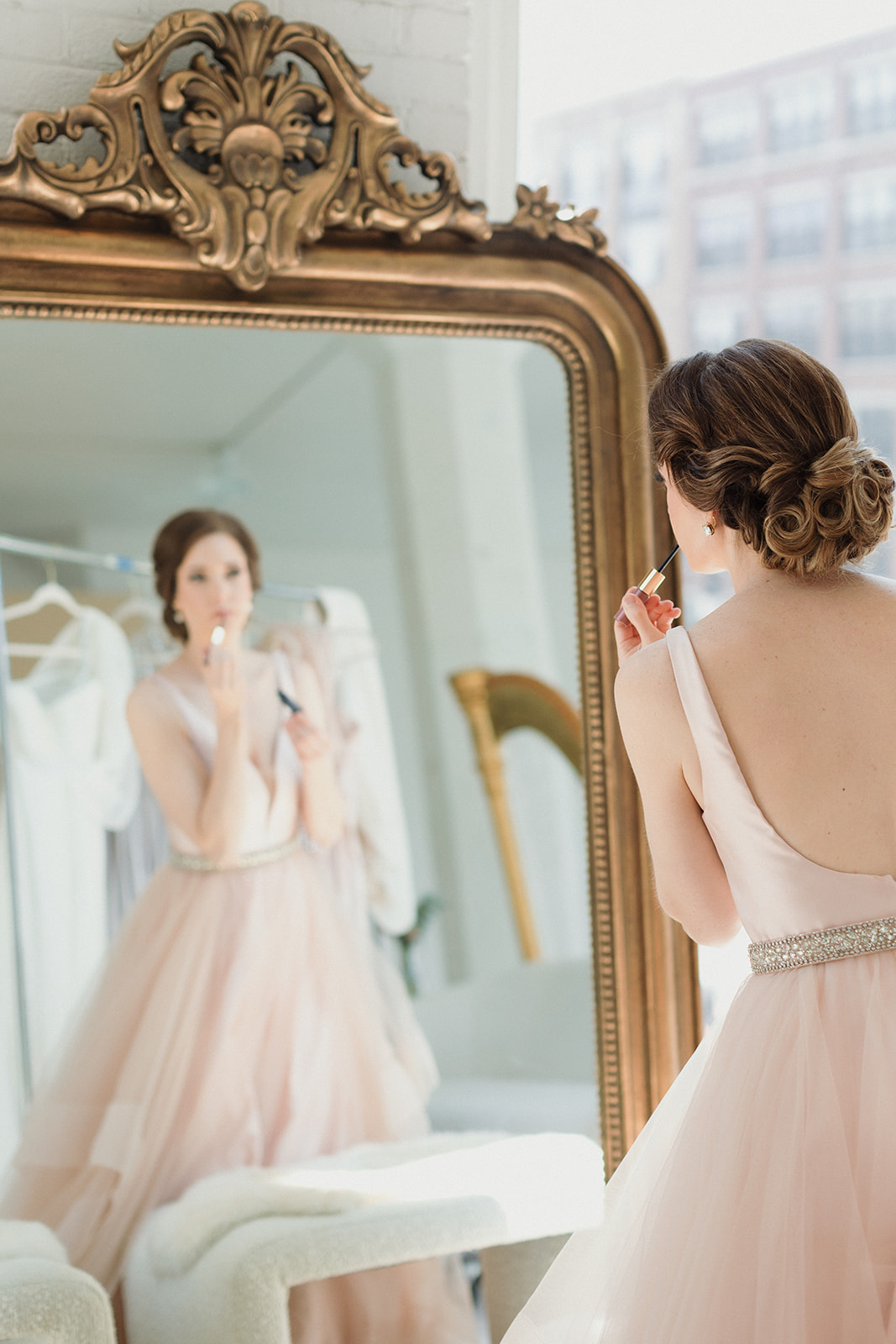
You look fine in the mirror, but then you feel like you look completely different in photos.
Well, you’re not imagining it. Many people feel just like you.
The reason you feel this isn’t that you suddenly look different or less attractive in photos. In fact, there are several psychological and technical reasons that seeing photos of yourself can feel jarring or uncomfortable.
Understanding these reasons can help to change how you see yourself in photos.
You’re used to what you see in the mirror
One of the biggest reasons photos look strange to us is something called the mere-exposure effect. In simple terms, we tend to prefer things that are familiar.
Usually the version of ourselves we see is our reflection in the mirror. But mirrors actually flip our image, and what we see is the opposite of what others see.
A photograph is capturing exactly what everyone else actually sees, and that can feel uncomfortable because it’s not what you’re used to seeing. Even small asymmetries suddenly feel noticeable.
If you’ve ever wondered why photos sometimes make you think “That doesn’t really look like me,” mirror reversal is usually the reason.
Camera lenses can distort faces
Another reason you might feel like you look worse in photos is lens distortion that your photographer is using on their camera. Different lenses capture faces in very different ways.
Without getting too in the weeds technically, wide-angle lenses often distort features when they’re too close to your face (your phone camera has a wide-angle lens).
When your face is close to the lens, it can make your nose appear larger, your face look wider, and your forehead look bigger. The distortion is subtle, but our brains are very good at spotting tiny differences in faces, especially our own.
Professional photographers can avoid this by using lenses that compress perspective in a more flattering way. For example, when I’m creating brand images of my client that are close up (ie, a portrait or headshot), I will always use a 50-70mm lens, which creates much less distortion, and therefore makes the subject’s face appear very similar to what it looks like in real life.
Some less experienced photographers will use wider angles for close-up photos, so it’s very important to know your photographer is experienced at portrait or headshot photography.
Photos freeze a moment that your brain normally ignores
In real life, people experience you as a moving, expressive human being. They see your facial expressions, body language, personality, energy, and context.
A photograph captures just one tiny fraction of a second.
Sometimes that split second happens mid-expression, mid-blink, or mid-movement. When we analyze a still image of ourselves, we often focus on small details we would never notice in real life.
We’re often more critical of ourselves
Many people, especially women, have been conditioned to scrutinize their appearance closely (hello, patriarchy, but that’s a different blog post!).
When we look at photos of ourselves, our brains immediately start scanning for perceived flaws. We actively look for things like:
- a double chin
- uneven smile
- squinty eyes
- a wrinkle we hadn’t noticed before
But others aren’t analyzing your photos like this. How they see an image of you is much more holistic, and includes things like your expression, your personality, and how your make them feel.
In the end, they’re not studying every tiny detail. They’re seeing you.
Why professional photos usually look better
If you’ve ever noticed that professional photos tend to look more flattering than selfies or casual pictures, it isn’t an accident.
A good brand photographer is considering several things during your session that make a big difference:
- choosing lenses that flatter facial proportions
- positioning the camera at the right angle
- using lighting to flatter the face
- guiding expression and posture
All of these factors work together to create images that look more like how people experience you in real life, and make you excited to become more visible as the face of your brand.
A different way to think about photos
If you’ve ever wondered why you look worse in photos than in the mirror, the answer usually has very little to do with how you actually look. Instead it’s a combination of familiarity, camera distortion, perspective, and self-criticism.
Once you understand those factors, photos often start to feel less confronting.
Read more…
If you’ve ever caught yourself thinking “I hate myself in photos,” you’re definitely not alone. I wrote more about the psychology behind our experiences in these blog posts:
Why Do I Hate Myself in Photos?
What Makes Someone Photogenic?